How FaceScore works
Perceived facial age, explained
Perceived facial age is influenced by visible characteristics. FaceScore evaluates those characteristics from three photos and reports what it sees — with clear limits on what that means.
What influences how old a face looks
Visible characteristics FaceScore considers
Wrinkles and expression lines
Lines that persist at rest tend to read as age.
Pigmentation and tone evenness
Uneven tone often reads as older than even tone.
Skin texture
Surface smoothness changes how light reflects off the face.
Volume and contour
Facial volume distribution affects perceived youthfulness.
Hair characteristics
Hairline, density and brow fullness frame the face.
Sun exposure appearance
Cumulative UV appearance is among the most visible factors.
Lifestyle-linked appearance
Sleep, hydration, alcohol and smoking can all change how a face presents.
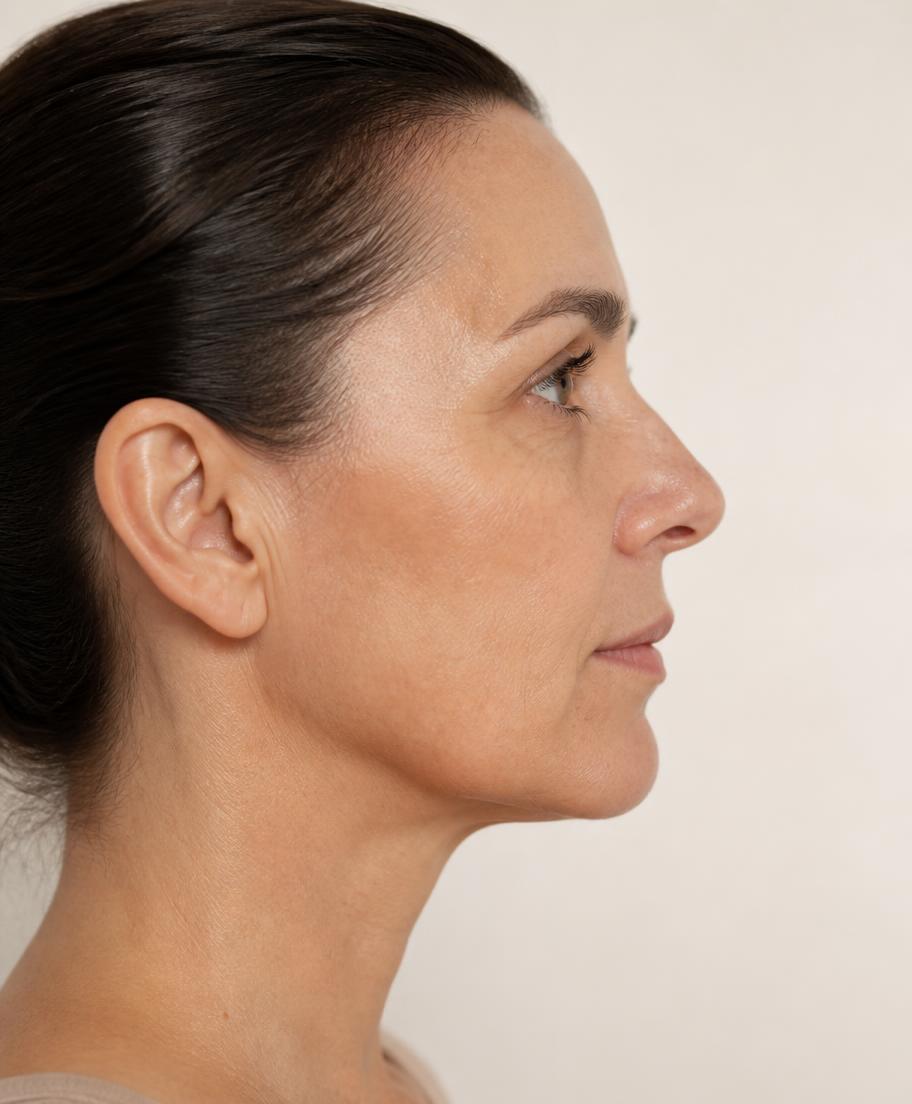
Why we ask for a side view
A straight-on photo shows tone, texture and symmetry. A side view adds jawline definition, neck contour and mid-face volume — characteristics that strongly influence how old a face appears to other people.
Three things that are not the same
Where FaceScore sits — and where it stops
Appearance estimation
What FaceScore does. An estimate of how old a face appears, based on visible characteristics in your photos.
Biological age
What FaceScore does not measure. Biological age relies on physiological and molecular markers that no photo can capture. FaceScore makes no biological-age claim.
Medical diagnosis
What FaceScore never provides. FaceScore cannot diagnose or rule out skin cancer, melanoma or any dermatologic disease, and does not replace a dermatologist.
Face Age is an AI-generated appearance estimate based on visible facial characteristics and should be viewed as an appearance assessment rather than a medical or biological-age measurement. Photo quality, lighting, angle, expression and filters all affect the estimate, so treat your Face Age as a directional read rather than a precise measurement.
Important health information
FaceScore does not diagnose medical conditions. If the analysis identifies visible characteristics that may warrant professional review, we may recommend consultation with a qualified dermatologist. FaceScore is not a diagnostic medical device and does not diagnose or rule out skin cancer, melanoma or dermatologic disease, and it does not replace a dermatologist or provide medical treatment.
Any new, changing, bleeding, painful, asymmetrical, irregular or otherwise concerning skin lesion should be evaluated by an appropriate healthcare professional.